In a single week this November, a Microsoft 365 and Outlook disruption, an FAA ground stop, and an Amtrak service halt reminded millions of people how quickly routine work stops when one upstream dependency drops. Those headlines are only the reminder: this field guide covers the layer below business continuity — what a household or small business actually executes step by step when cloud apps, broadband, cellular service, or the electric grid fail.
Quick answer: Continuity at the household and small-business level does not depend on enterprise failover clusters. It depends on knowing which exact layer failed — one SaaS service, local internet, cellular networks, or grid power — and switching immediately to a pre-staged analog or local fallback you printed, downloaded, and tested while everything was still online.
Download the Printable Failure Ladder & Contact-Tree Sheet
Every number, legal rule, and safety threshold below traces directly to primary federal, emergency-management, and technical authorities linked inline. Where agencies differ on planning horizons or a practical figure is a rule of thumb rather than a statutory limit, it is labeled as such.
Why One Upstream Outage Breaks “Disconnected” Work
Most home routines and small-business workflows look independent on paper until an outage hits. A shop cannot take cards because its point-of-sale tablet needs LTE or broadband; a crew cannot read today’s dispatch because the schedule lives inside a cloud calendar; a family cannot confirm a prescription pickup or reach relatives because phone numbers sit in a synced address book instead of on paper.
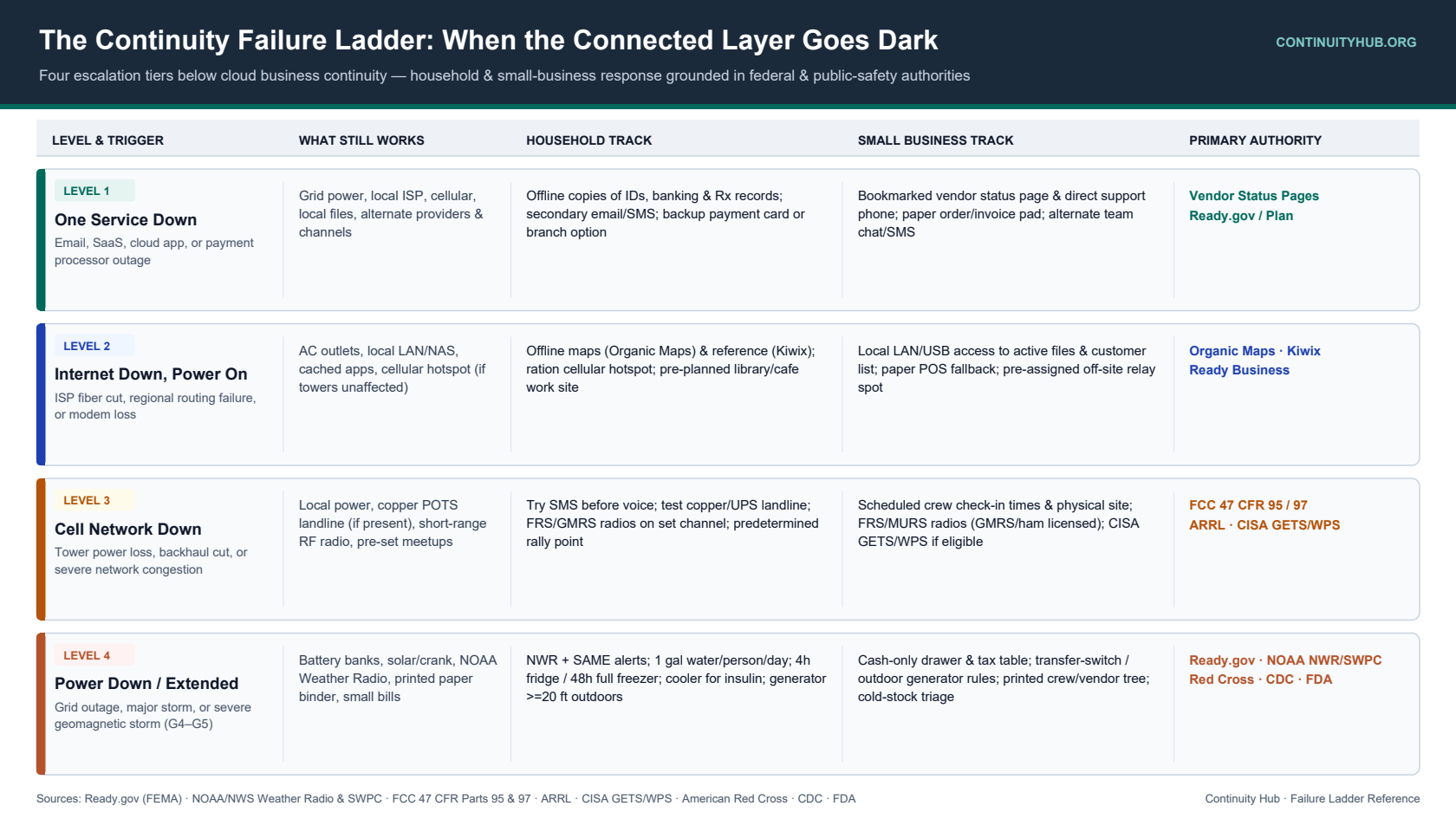
As Continuity Hub’s business continuity planning overview and vendor dependency audit guide emphasize, a plan that names cloud vendors without naming local fallbacks simply moves your single point of failure outside your building. Treating disruptions as a four-level failure ladder turns an overwhelming crisis into a concrete triage decision: move down one rung, pull the matching binder or kit, and keep operating.
Level 1 — One Service Down (Email, Payments, or a Core SaaS App Out)
At Level 1, your lights are on, your router is green, and cellular signal bars are normal — only a single provider, cloud region, payment processor, or identity service is broken.
What Still Works vs. What Stops
- Still works: Local files stored on your device, local networks, SMS/phone calls, alternative messaging apps, paper records, and offline payment methods.
- Stops working: Sign-in flows tied to the broken identity provider, shared calendars, cloud-only ticket queues, card terminals routed through one gateway, and inbox-based alerts hosted on the affected platform.
Pre-Staged Status Checks and Escalation Contacts
Checking third-party rumor threads wastes the first 20 minutes of an outage. Bookmark and save the primary status endpoints and direct support telephone numbers for your critical tools before they fail:
- Microsoft 365 & Outlook: Check Microsoft Service Health Status on an alternate browser or cellular connection.
- Internet Edge & DNS Routing: Check Cloudflare System Status when multiple unrelated websites fail to load at once.
- Developer & Deployment Tooling: Check GitHub Status before assuming local build pipelines broke on your side.
- Multi-provider resilience: If an application outage stems from a single cloud provider region, review Continuity Hub’s multi-provider redundancy checklist and supply chain cyber disruption guide.
Household Track (Level 1)
- Keep offline copies of time-sensitive confirmations: Save PDFs or printouts of boarding passes, medical appointments, utility account numbers, and school pickup notices locally on your phone or in a folder.
- Maintain one secondary contact path per person: Pair work email with a personal SMS number and a separate-provider email alias for urgent household handoffs.
- Verify bank and card issuer phone numbers: Write the toll-free number on the back of your primary payment card into your emergency folder so you are not searching for it if a banking app fails.
Small Business Track (Level 1)
- Export tomorrow’s schedule every afternoon: Export the next 48 hours of dispatches, appointments, delivery addresses, and customer phone numbers to a local CSV or PDF on the manager’s laptop or tablet so crews are never locked out by a SaaS login outage.
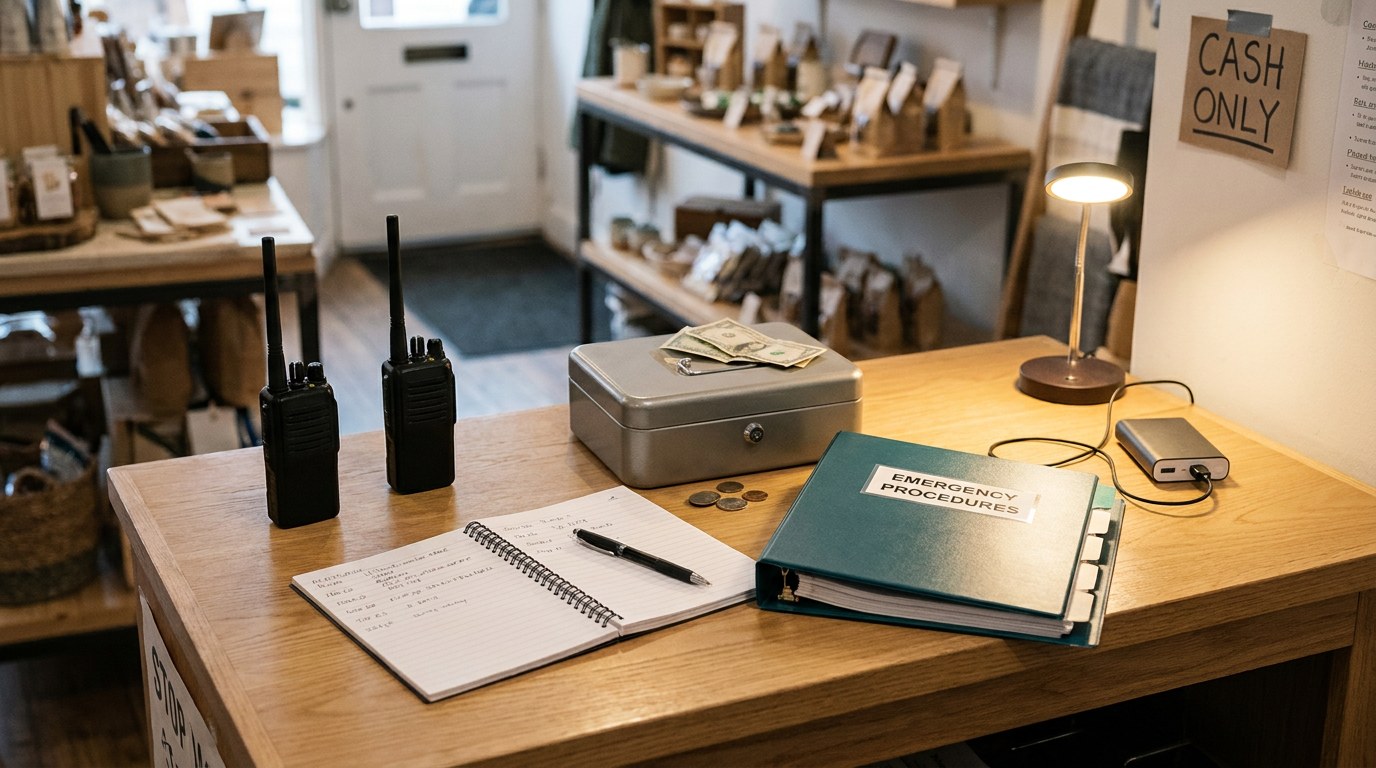
- Stage an offline cash and manual receipt fallback: Keep a locked cash drawer with small bills, a pre-printed paper receipt logbook, and clear staff rules on cash-only intake — never improvise card-number writing on loose paper, which violates PCI DSS cardholder data protections.
- Hold direct non-portal vendor numbers: Store direct phone extensions for your fuel supplier, POS processor, payroll desk, and landlord in a printed binder alongside your account numbers, matching Ready.gov’s Ready Business guidance.
Level 2 — Internet Down, Power On (LAN Running; WAN Gone)
At Level 2, municipal or building power stays on, but neighborhood fiber, cable broadband, or regional ISP routing goes dark — often taking neighborhood cellular data speeds down with it as devices crowd remaining towers.
What Still Works Locally
Even with the modem’s WAN light blinking red, your powered local area network (LAN) still routes traffic inside your home or shop:
- Shared folders on a local NAS or office server remain reachable over Ethernet and local Wi-Fi.
- Wired network printers, local point-of-sale receipt printers connected over LAN, and locally synced desktop folders still function.
- Pre-downloaded offline archives, street maps, and local-first Markdown/text runbooks open instantaneously without cloud round-trips.
Local-First and Offline Tools to Pre-Stage
Download these free, non-commercial tools while your broadband connection is fast and healthy:
- Offline reference archives: Kiwix stores compressed copies of medical references, Wikipedia, technical manuals, and how-to guides on an ordinary laptop, USB drive, or phone for zero-connectivity lookup.
- Offline turn-by-turn maps: Organic Maps lets you download full state or regional OpenStreetMap road and trail packages ahead of time so GPS routing keeps working with zero mobile data.
- Short-range off-grid text mesh: Meshtastic runs low-power LoRa transceivers on license-free ISM bands to relay encrypted short text messages peer-to-peer between family members or field crews across several kilometers without internet or cell towers.
Pre-Planned Relocation (“Coffee-Shop Run” as a Protocol, Not Improvisation)
When home or office fiber breaks for hours, driving around looking for open Wi-Fi wastes battery and exposes logins. Treat off-site failover as an explicit protocol:
- Scout two distinct ISP footprints in advance: Identify a public library, coworking space, or café at least 3–5 miles away that uses a different physical ISP or cellular carrier than your primary building.
- Check MFA and hardware keys before walking out the door: Verify that your authentication method does not rely solely on a desk hardware token or broken email inbox; Continuity Hub’s backup authentication and MFA review and immutable backup strategy guide explain how identity lockouts compound outage recovery.
- Use offline sync carefully: Bring pre-staged local work files on encrypted removable storage so only final transfers require borrowed bandwidth.
Household and Small Business Tracks (Level 2)
- Household Track: Cache regional maps in Organic Maps for every driver’s phone, load emergency medical/home-repair Kiwix ZIM files onto one laptop or tablet, and confirm who drives to the pre-scouted library if remote school or telehealth work must be uploaded.
- Small Business Track: Maintain a daily local snapshot of open invoices, inventory SKUs, customer contacts, and supplier purchase orders on an office machine or encrypted flash drive; pre-authorize one manager with petty cash and mobile hotspot fallback rules under your business continuity plan and Ready.gov continuity planning steps.
Level 3 — Cell Network Down (Voice, SMS, and Mobile Data Unavailable or Congested)
At Level 3, storms, fiber cuts, tower power loss, or mass network congestion knock out cellular voice, text messaging, and LTE/5G data across your area.
Landlines, VoIP, Wi-Fi Calling Limits, and Emergency Calling
Do not assume a landline telephone or Wi-Fi calling icon protects you without checking the wiring behind your wall jack:
- Traditional copper landlines (POTS): Phones plugged directly into analog copper lines powered by telephone company central office batteries often keep working during home power outages — unless the handset itself is a cordless base station that plugs into an AC wall outlet. Keep one simple corded handset in the kit.
- Cable and fiber VoIP home phone lines: Voice service delivered through a cable modem or optical network terminal (ONT) stops immediately when local power fails unless connected to a working uninterruptible power supply (UPS) or provider backup battery (typically rated around 8 hours on standby batteries; check your ISP’s hardware specs). Keep your physical street address registered for E911 dispatch.
- Wi-Fi calling: Wi-Fi calling helps only when cellular reception is weak and your local broadband plus AC/UPS power remain online. When both WAN internet and cell towers fail, Wi-Fi calling fails too.
- Conserving congested networks: If towers are only partially degraded, text messages require far less network bandwidth than voice calls and often go through when calls drop. Practical rule of thumb: wait at least 10 seconds before redialing a failed emergency or priority call to avoid compounding switch congestion, and reserve calls for urgent life-safety or operational needs.
Qualifying Business & Response Priority: CISA GETS and WPS
Eligible public-safety, healthcare, utility, government, financial, and disaster-recovery personnel should enroll before a disaster in the U.S. Cybersecurity and Infrastructure Security Agency (CISA) priority calling programs, which carry $0 enrollment and usage fees from CISA (standard carrier airtime charges still apply):
- Government Emergency Telecommunications Service (CISA GETS): Prioritizes wireline, cellular, and satellite calls across congested public switched networks via PIN access codes, engineered for a 98% call-completion rate.
- Wireless Priority Service (CISA WPS): Adds
*272cellular priority dialing on participating carrier phones, engineered for a 95% call-completion rate during severe network congestion.
Civilian Radio Services: Legally Accurate Comparison (47 CFR Parts 95 & 97)
When phones fail completely, handheld two-way radios fill the gap across neighborhoods, parking lots, and work sites — provided you choose a service whose FCC legal rules fit your users. Every entry below is grounded in 47 CFR Part 95 (Personal Radio Services) and 47 CFR Part 97 (Amateur Radio Service):
| Radio Service (CFR Citation) | License & Exam | Allowed Use | Channels / Band & Power Limits | Best Fit in an Outage |
|---|---|---|---|---|
| FRS — Family Radio Service (47 CFR Part 95 Subpart B) | None (licensed by rule; no fee, no exam) | Personal or small business use | 22 channels (462/467 MHz UHF); non-removable antenna; max 2.0 W ERP (Ch. 1–7, 15–22) and 0.5 W ERP (Ch. 8–14) | Short-range family, parking lot, and on-site retail crew coordination (typically under 0.5–2 miles depending on terrain) |
| MURS — Multi-Use Radio Service (47 CFR Part 95 Subpart J) | None (licensed by rule; no fee, no exam) | Personal or business use | 5 VHF channels (151.820, 151.880, 151.940, 154.570, 154.600 MHz); max 2 W transmitter power; repeaters prohibited | Businesses, farms, and small facilities needing license-free business VHF handheld range outdoors and around buildings |
| CB — Citizens Band Radio (47 CFR Part 95 Subpart D) | None (licensed by rule; no fee, no exam) | Personal or business use | 40 channels (~27 MHz); max 4 W AM/FM carrier or 12 W PEP SSB; Ch. 9 reserved for emergencies/travelers; external amps banned | Vehicles, delivery vans, highway corridors, and mobile logistics teams checking road status |
| GMRS — General Mobile Radio Service (47 CFR Part 95 Subpart E) | Individual FCC license required (10-year term, fee, no exam) | Individual licensee + immediate family; no new corporate/non-family employee licenses (grandfathered pre-July 31, 1987 only) | 30 channels (462/467 MHz); repeaters allowed; up to 50 W mobile/base/repeater (462/467 main), 5 W ERP (462 interstitial), 0.5 W ERP handheld (467 interstitial) | Higher-power extended-family regional coordination via local GMRS repeaters |
| Amateur Radio (Ham) (47 CFR Part 97) | Individual FCC license + exam required (10-year term; Technician = 35q, no Morse code) | Strictly non-commercial; business traffic is prohibited (even during routine outages) | Full VHF/UHF repeaters, satellite, and HF regional/global bands (per Technician, General, or Extra privileges) | Long-distance personal wellness relays and community public service via ARRL ARES |
To earn an entry-level Technician ham license, consult the ARRL Getting Licensed guide and locate an online or local test via the ARRL exam session finder.
Predetermined Meetup and Check-In Plans
Two-way radios and phone alerts only work if everyone knows when and where to check in before batteries run flat. Following Ready.gov’s family communication plan framework:
- Set two physical rally points: One just outside your home or shop (for sudden building evacuations) and one outside your immediate neighborhood or industrial park (if roads close).
- Name one out-of-area relay contact: Local calls often fail while long-distance calls or texts still route; every household member calls or texts that single distant relative to report location.
- Schedule fixed radio listening windows (rule of thumb): Monitor agreed FRS/MURS/GMRS channels for 10 minutes at the top of every even hour (e.g., 08:00, 10:00, 12:00) so handheld batteries last days instead of dying on continuous scan.
Household and Small Business Tracks (Level 3)
- Household Track: Store one corded POTS handset if you retain copper service, place laminated family wallet cards with your out-of-area relay contact in backpacks and gloveboxes, and keep a matched pair of FRS radios with labeled primary/backup channel stickers (avoiding privacy-tone confusion — remember privacy codes only mute speakers; they do not encrypt).
- Small Business Track: Because new GMRS licenses do not cover non-family employees and Amateur Radio bars commercial traffic, equip crews with license-free MURS or FRS handhelds (plus CB in service trucks), post laminated check-in schedules and rally maps beside exit doors matching your OSHA-aligned emergency action plan and emergency communication redundancy protocols.
Level 4 — Power Down / Extended Outage (Including Solar Flare / CME Scenarios)
At Level 4, the electric grid fails alongside internet and cellular infrastructure for hours or days. Everything shifts from digital convenience to life safety, analog alerting, thermal/cold-chain preservation, cash transactions, and printed runbooks.
NOAA Weather Radio (NWR) and County SAME Alerts
When commercial AM/FM stations go off the air or internet streams die, battery- and hand-crank-powered NOAA Weather Radio receivers remain one of the most resilient public alerting backbones in the United States:
- The NOAA Weather Radio network broadcasts continuous National Weather Service warnings, watches, forecasts, and non-weather civil emergency alerts across more than 1,000 transmitters covering all 50 states, coastal waters, Puerto Rico, the U.S. Virgin Islands, and Pacific territories.
- Transmitters operate on seven dedicated VHF frequencies:
162.400,162.425,162.450,162.475,162.500,162.525, and162.550 MHz, with a typical reception radius of roughly 40 miles over level terrain. - Program your radio with your county’s 6-digit Specific Area Message Encoding code via the NOAA NWR SAME county directory and verify nearby transmitter frequencies on the NWR station listing (or toll-free at
1-888-697-7263) so alerts wake you automatically without draining batteries on irrelevant distant counties.
Solar Flares and Geomagnetic Storms (CMEs): A Measured Reading
Severe space weather is an occasional real-world grid and communications hazard — not science fiction. Based on the NOAA Space Weather Prediction Center (SWPC), NOAA Space Weather Scales, and Ready.gov Space Weather guidance:
- Solar Flares (
R1–R5Radio Blackouts): X-ray and ultraviolet bursts travel at the speed of light (roughly 8 minutes to Earth), ionizing the sunlit D-layer of the ionosphere. SWPC solar flare impacts cause minutes-to-hours blackouts of high-frequency (3–30 MHz) maritime, aviation, and amateur skywave radio and can degrade low-frequency navigation signals on the sunlit side of Earth. They do not directly knock out local home wiring or shut off vehicle ignitions. - Coronal Mass Ejections / Geomagnetic Storms (
G1–G5): Cloud-sized bursts of magnetized solar plasma take longer to arrive — typically several days, or as little as ~18 hours for the fastest, most intense CMEs (SWPC geomagnetic storm guide). Only the highest tiers (G4 Severe and G5 Extreme) pose significant risks of widespread power-grid voltage control problems, protective relay trips, transformer overheating/damage, or regional blackouts via geomagnetically induced currents (GICs), alongside GPS/GNSS positioning errors, satellite orientation issues, and increased low-Earth-orbit drag. - Practical takeaway: Space-weather readiness uses the exact same Level 3 and Level 4 kit as a severe ice storm or hurricane — backup grid-free lighting, NWR weather radio, cash, water, cold-chain plans, and printed paper contacts — without buying speculative shield boxes or doomsday gear.
Power, Charging, Water, Food, Cold-Chain Medications, and Cash
Follow verified federal and Red Cross thresholds carefully during multi-day blackouts:
- Water supply: Ready.gov Build A Kit specifies 1 gallon per person per day for drinking and sanitation (at least a 3-day baseline in an evacuation kit, and a larger 2-week supply when sheltering at home per American Red Cross survival kit standards).
- Food refrigeration and spoilage: Keep appliance doors shut. Per Ready.gov Power Outages, an unopened refrigerator keeps food safely cold for roughly 4 hours, a full freezer holds safe temperatures for 48 hours (24 hours if half full), and any perishable food (meat, poultry, fish, eggs, leftovers) held at 40°F or higher for 2 hours or more must be discarded. Keep appliance thermometers inside both compartments so you never guess.
- Insulin and temperature-sensitive medications: Per U.S. FDA emergency insulin storage guidance, store unopened insulin refrigerated at 36°F–46°F (
2°C–8°C). Most unopened or in-use manufacturer vials and cartridges may be kept unrefrigerated between 59°F and 86°F for up to 28 days (certain specific pens and formulations differ — check the package insert; diluted or drawn insulin is shorter at 14 days), and insulin must never be frozen or placed directly against ice packs. Ready.gov advises contacting your doctor or pharmacist for guidance if power stays out more than 1 day, and the Red Cross recommends maintaining at least a 7-day supply of critical prescription medications. - Small-bill cash: Keep cash in small denominations stored at home or in a go-bag (Ready.gov Financial Preparedness) because card readers, ATMs, and fuel pumps routinely go offline during regional blackouts.
- Fuel and power banks: Keep hand-crank/solar chargers and portable USB battery banks topped up; keep vehicle fuel tanks at least half full (Ready.gov) because retail gas station dispensers rely on grid power.
Generator and Carbon Monoxide (CO) Safety — Non-Negotiable Rules
Wrong generator placement kills more people after major storms than the storm itself. Per Ready.gov Power Outages and Red Cross Power Outage Safety:
- Operate portable generators outdoors ONLY, at least 20 feet away from windows, doors, vents, and attached garages, with exhaust pointed away from every building.
- Maintain battery-backed Carbon Monoxide (CO) alarms on every occupied floor and outside sleeping areas; evacuate to fresh air immediately and call 911 if an alarm sounds or anyone feels dizzy, nauseated, or drowsy.
- Never run gas stoves, ovens, charcoal grills, propane heaters designed for outdoor use, or generators inside homes, basements, garages, enclosed porches, or tents.
- Prevent electrical backfeeding: Plug appliances directly into the generator with heavy-duty, outdoor-rated cords OR use a licensed electrician’s transfer switch. Never plug a generator into a wall outlet — backfeeding can electrocute utility lineworkers and start fires. Let generators cool completely before refueling.
- Stay at least 35 feet away from downed power lines and assume every fallen wire is energized (Red Cross).
What to Print TODAY While Everything Still Works
Paper weighs ounces, never hits an MFA timeout, and works in the dark with a flashlight. Print two copies (one for your home go-binder, one for your shop counter or manager desk):
- Completed Contact-Tree & Rally-Point Sheet (included on the final page of this guide’s printable PDF) — family/crew phone numbers, out-of-area relay contact, two physical rally locations, utility emergency numbers, insurer claim hotlines, and primary bank/POS phone lines.
- Primary Care, Pharmacy & Medical Profiles — prescription dosages, pharmacy phone/address, insurance policy numbers, allergies, and medical device backup power needs.
- County NOAA Weather Radio SAME Code & Local Broadcast Frequencies — exact county SAME number plus local AM/FM emergency stations and agreed FRS/MURS/GMRS/CB channels.
- Facility Shutoff Diagram & Vendor Escalation List — main breaker panel map, water main valve location, gas shutoff instructions (only shut off gas if you smell gas or suspect a leak; only the utility restores it), generator load-shedding sequence, and direct non-portal phone numbers for critical suppliers.
- Pre-Scouted Secondary Site & Paper Receipt Log Forms — street addresses of your two backup ISP locations (printed with turn-by-turn directions in case phones die) plus carbon/numbered offline sales receipt sheets for small shops.
Household and Small Business Tracks (Level 4)
- Household Track: Verify CO detector batteries, measure a real 20-foot clearance spot outside before you ever wheel out a generator, stage your 1-gal/person/day water reserve and cooler/medication plan, and keep your printed contact binder plus small bills in a waterproof pouch.
- Small Business Track: Train opening/closing supervisors on manual receipt logging, facility lockup when electronic keypads fail, cold-chain shutoff or transfer-switch procedures, crew release rules, and stakeholder updates per Continuity Hub’s facility life-safety manual, crisis communication protocols, and the SBA emergency preparedness guide.
Named Tools & Official Authorities (One Line Each)
- Ready.gov Power Outages — Federal generator 20-foot placement, refrigerator 4-hour/freezer 48-hour spoilage windows, and outage safety checklist.
- Ready.gov Build A Kit — Baseline 1-gallon-per-person-per-day water, food, flashlight, battery radio, and go-bag supply standards.
- Ready.gov Make A Plan — Household communication cards, out-of-area contact structure, and emergency meetup planning templates.
- Ready.gov Financial Preparedness — Cash reserves, critical policy/document inventory, and post-disaster financial continuity guidance.
- Ready.gov Ready Business — Small-business continuity worksheets, supplier impact assessment, and staff coordination guides.
- NOAA Weather Radio — 24/7 VHF hazard alerting network across >1,000 U.S. transmitters with county SAME filter codes.
- NOAA Space Weather Prediction Center — Measured R1–R5 radio blackout and G1–G5 geomagnetic storm scales for HF radio, GPS, and grid risk.
- U.S. FDA Insulin Storage Guide — Verified refrigerated (36°F–46°F) and temporary unrefrigerated (59°F–86°F up to 28 days) insulin storage rules during blackouts.
- 47 CFR Part 95 (eCFR) — Legal FCC rules, power caps, and eligibility for FRS, MURS, CB, and GMRS personal and business radio use.
- 47 CFR Part 97 (eCFR) — Legal FCC Amateur Radio rules, exam classes, and strict non-commercial operating restrictions.
- ARRL Getting Licensed & ARES — Exam preparation, local/remote test session search, and emergency volunteer radio organization (ARES).
- CISA GETS & WPS — Free-enrollment priority landline and
*272cellular calling programs for eligible critical-infrastructure and response organizations. - American Red Cross Power Outage Safety — Downed-line 35-foot clearance, 7-day medication reserve, and two-week stay-at-home supply guidance.
- Kiwix — Free offline knowledge reader storing Wikipedia, medical guides, and manuals locally with zero internet required.
- Organic Maps — Free, open-source offline OpenStreetMap driving, walking, and trail navigation app using GPS without mobile data.
- Meshtastic — Open-source off-grid LoRa mesh messaging platform for license-free short text coordination without cell towers.
“Do This Weekend”: 10 Things to Set Up While Nothing Is Broken
- Print and fill out your Contact-Tree & Rally-Point Sheet (last page of the downloadable PDF) for both home and workplace, plus wallet cards for every household member and key staff lead.
- Export tomorrow’s critical digital records offline: Save local PDFs of key insurance policies, prescriptions, vendor numbers, and tomorrow’s customer/crew schedules onto encrypted local storage and paper.
- Cache offline regional maps in Organic Maps on every phone and load one offline medical/reference archive in Kiwix on a charged laptop or tablet.
- Stage a cash envelope in small bills ($1s, $5s, $10s, $20s) for household purchases and a locked petty-cash box plus blank receipt logbook for small-business counter sales.
- Buy or test a battery/hand-crank NOAA Weather Radio and program your county’s 6-digit SAME code.
- Pick and label your legal two-way radios: Choose license-free FRS or MURS handhelds for mixed staff/family simplicity (or obtain an individual GMRS/ham license where appropriate), mark Channels 1 and 2 on tape, and verify charger batteries.
- Plug in one corded landline phone (if you retain copper POTS service) or test the standby runtime of your cable/fiber VoIP backup battery and confirm your registered E911 physical address.
- Scout and bookmark two backup Wi-Fi locations on a different ISP plus bookmark primary status pages (Microsoft, Cloudflare, GitHub) and check your MFA recovery methods.
- Verify water, CO alarms, and medication cooling: Stage 1 gallon/person/day water, replace backup batteries in CO alarms on every floor, add refrigerator/freezer thermometers, and keep insulated cooler packs ready (never freezing insulin).
- Mark a real 20-foot outdoor generator spot (if you own a generator), inspect outdoor heavy-duty cords or transfer switch operation, and test the entire weekend kit with one 30-minute “phones-on-airplane-mode” check-in drill.
Print-Ready Companion PDF & Contact-Tree Worksheet
Keep the printed version in a kitchen drawer or shop emergency binder alongside your flashlights and cash box. Every checklist above renders with printable paper checkboxes, and the final page is a blank Contact-Tree, Business Escalation & Radio Plan Worksheet formatted for crisp black-and-white printing.
Print the Complete 10-Page Guide + Blank Contact-Tree Template
Practical disclaimer: This guide synthesizes public safety, emergency preparedness, medical cold-chain, and federal radio licensing references for operational planning purposes. It does not constitute legal, medical, electrical engineering, or tax advice. Verify medication-specific storage limits with your pharmacist or physician, hire licensed electricians for generator transfer switches, and consult 47 CFR Parts 95/97 or legal counsel before deploying commercial radio systems.