Most business continuity plans assume an outage starts when a cloud region or carrier fails—not when your own security desk pulls the master API key running intake, triage, and dispatch queues. Because commercial AI workflows rely on anonymous, replayable bearer keys, emergency revocation mid-crisis triggers a self-inflicted operational blackout. This guide translates autumn 2026 outage post-mortems and credential-theft alerts into practical continuity controls, and evaluates how certified compute—a proposed concept that does not exist commercially today—would isolate leaked token batches without blinding live operations.
In When the Internet Goes Dark, we walked households and small operations down the practical failure ladder: what breaks ten minutes after upstream connectivity drops, which cloud portals lock you out, and why paper and radio fallbacks only work when staged on a calm Tuesday. Between September 15 and November 14, 2026, enterprise continuity planners watched that failure ladder unfold across hospitals, offices, and national airspace.
The same 60-day window exposed a quieter continuity blind spot for teams running AI inside daily workflows—ticket triage, clinical or claims intake, dispatch routing, and automated runbooks. An operational halt no longer requires a data center power fault. If an attacker scrapes one shared API key, your incident commander must choose between funding an active intrusion or revoking the secret and taking your own production queues dark.
That operational deadlock motivates certified compute: an analytical model in which a named lab mints inference capacity in discrete workload-bound tranches, watermarks units at expenditure, enforces single-spend replay locks, and re-issues capacity to attested queues when a tranche leaks while standing behind counterfeit risk. No cloud vendor, frontier lab, or standards body sells certified compute today—it remains strictly a resilience design proposal. Stress-testing the model against autumn 2026 disruptions nonetheless exposes why static bearer keys fracture continuity plans—and what planners must inventory and rehearse right now.
Operational AI Key-Kill & Continuity Field Sheet (PDF)
When Pulling a Compromised AI Key Triggers a Self-Inflicted Blackout
Foundational contingency playbooks—including NIST SP 800-34 Rev. 1, the Ready.gov Business Continuity Planning Guide, and CISA cybersecurity baselines—assume an outage begins when a physical site floods or a cloud region goes unreachable. Embedding commercial AI inside daily intake, triage, and dispatch creates a different failure mode: external uptime monitors such as the Microsoft Service Health Status Dashboard stay green while your own incident response freezes internal production.
Between September 15 and November 14, 2026, federal advisories and vendor incident bulletins documented automated credential parasitism aimed directly at pooled inference keys and routing proxies:
- ARTEX Broker Harvesting (
FLASH-20261113-001): Across decoy environments operated by Amazon MadPot between October 3 and November 5, 2026, Amazon Threat Intelligence observed autonomous ARTEX agents finishing full intrusion chains inside a three-hour window. As detailed in the November 13, 2026 FBI IC3 FLASH-20261113-001 advisory, ARTEX specifically targeted LiteLLM and One API middleware to loot live API secrets and subsidize external model calls. - Downstream Spillover at Fireworks AI: Back-to-back October compromises reported in Fireworks AI’s October 2026 security bulletin (October 6 and October 23–24, 2026) paired unauthorized LLMJacking compute drain with an internal R&D lateral pivot reviewed by Unit 42—spilling into connected SaaS workflows and exposing fewer than 1% of customer chat histories at Notion.
- ‘Black October’ Supply-Chain Windows: Incident data compiled in Black October 2026 tracked compressed exploit timelines around October 21—including PHP2Shell (CVSS 9.2), GitLab RCE (CVSS 10.0), and malicious LiteLLM PyPI package tampering aimed at proxy credentials.
- Unmapped Machine Ratios: Findings in the State of NHI and AI Agent Breaches Report show non-human and OAuth credentials outnumbering staff 45:1 to 144:1; roughly 30% (71 of 239) of studied AI compromises entered through SaaS/OAuth grants and 44% relied on stolen credentials.
Application-layer prompt filters offer zero protection during a key leak. Not only did a June 2026 NIST mathematical proof (via Gödel’s incompleteness theorems) establish that finite static rules can never close open-ended text inputs, but an external operator holding your raw API key never touches your application stack—calling the upstream model endpoint directly on your meter.
That failure pattern echoes the third-party cascade mapped in Supply Chain Cybersecurity: When the Vendor Incident Becomes Your Outage and poses a direct operational test: when daily queues depend on commercial inference, can your team sever a compromised secret without shutting down healthy internal services?
External Monoculture Failures vs. Internal Key-Kill Blackouts
Separating internal credential blackouts from external infrastructure outages is essential because the two failure modes demand completely different runbooks. Between October 20 and November 14, 2026, three high-profile service halts triggered widespread speculation about a coordinated cyber event—yet official engineering post-mortems and federal briefings confirmed zero malicious code across all three. Operations stalled because organizations depended on single-provider control planes and unverified physical failover paths:
- October 20, 2026 — Google Cloud London (
europe-west2-b): Per Google Cloud incident Xs2XTHzAVC9YnafnPyzj, London’seurope-west2-bzone lost power for 6 hours and 8 minutes across 38 cloud services. With Feeder B isolated under lockout/tagout since October 14 and Feeder A lost to an October 20 underground cable fault, redundant PLCs wired upstream of Feeder B’s open breaker misread live grid voltage and left standby diesels idle—exhausting UPS reserves (~5 minutes rated) in roughly 7 minutes by 07:00 BST. - November 12–14, 2026 — Microsoft 365 and Copilot (
MO1550821): Tenant access degraded for more than 24 hours across 74+ countries prior to full recovery. Per MO1550821 remediation disclosures, a capacity-scaling rollout and configuration update broke automated server health probes and saturated TLS connection handlers—forcing UK National Health Service wards onto bedside paper records, Ireland’s Health Service Executive onto handwritten scripts, and Tokyo enterprises back onto PSTN landlines and fax. - November 13, 2026 — U.S. FAA Nationwide Ground Stop: Commercial departures paused nationwide for 4 hours and 20 minutes (3:54–8:15 p.m. EST) while Microsoft’s recovery was still underway. At a joint DHS and DOT briefing, federal officials confirmed that scheduled contractor work migrating 1980s-era analog copper circuits onto fiber saturated regional routing gear—unrelated to Microsoft or hostile activity.
| Failure Mode & 2026 Precedent | Vendor Status Signal | Operational Breakdown | Offline Fallback Required |
|---|---|---|---|
| SaaS Control-Plane Outage (M365 MO1550821, >24h, 74+ countries) | Red global incident advisories | Cloud email, Copilot, Teams & SharePoint portals unreachable | Paper clinical/intake forms, PSTN landlines, offline binder runbooks |
| Legacy Transport Overload (FAA Nov 13, 4h 20m, 3:54–8:15 p.m. EST) | Federal ground-stop alert | 1980s copper-to-fiber cutover saturated regional telecom switches | Independent out-of-band comms separate from primary carrier circuits |
| Zone Power & Sensor Cascade (GCP europe-west2-b, Oct 20, 6h 8m) | Zone outage across 38 services | Line-side PLC voltage sense left generators idle; ~7 min UPS drain | True multi-provider cutover rather than single-zone failover assumptions |
| Shared AI Key Revocation (ARTEX FLASH-20261113-001 / LiteLLM) | Green upstream status pages | Emergency key kill drops internal triage, intake & dispatch on HTTP 401 | Per-queue key bulkheads, secondary provider keys & rule/paper step-down |
As examined in Your Plan Names the Vendor. Has It Ever Survived the Vendor Failing? and A Second Region Is Not a Second Provider, redundancy on paper evaporates whenever separate queues share one hidden dependency—whether that dependency is a miswired PLC sensor or one master API bearer string.
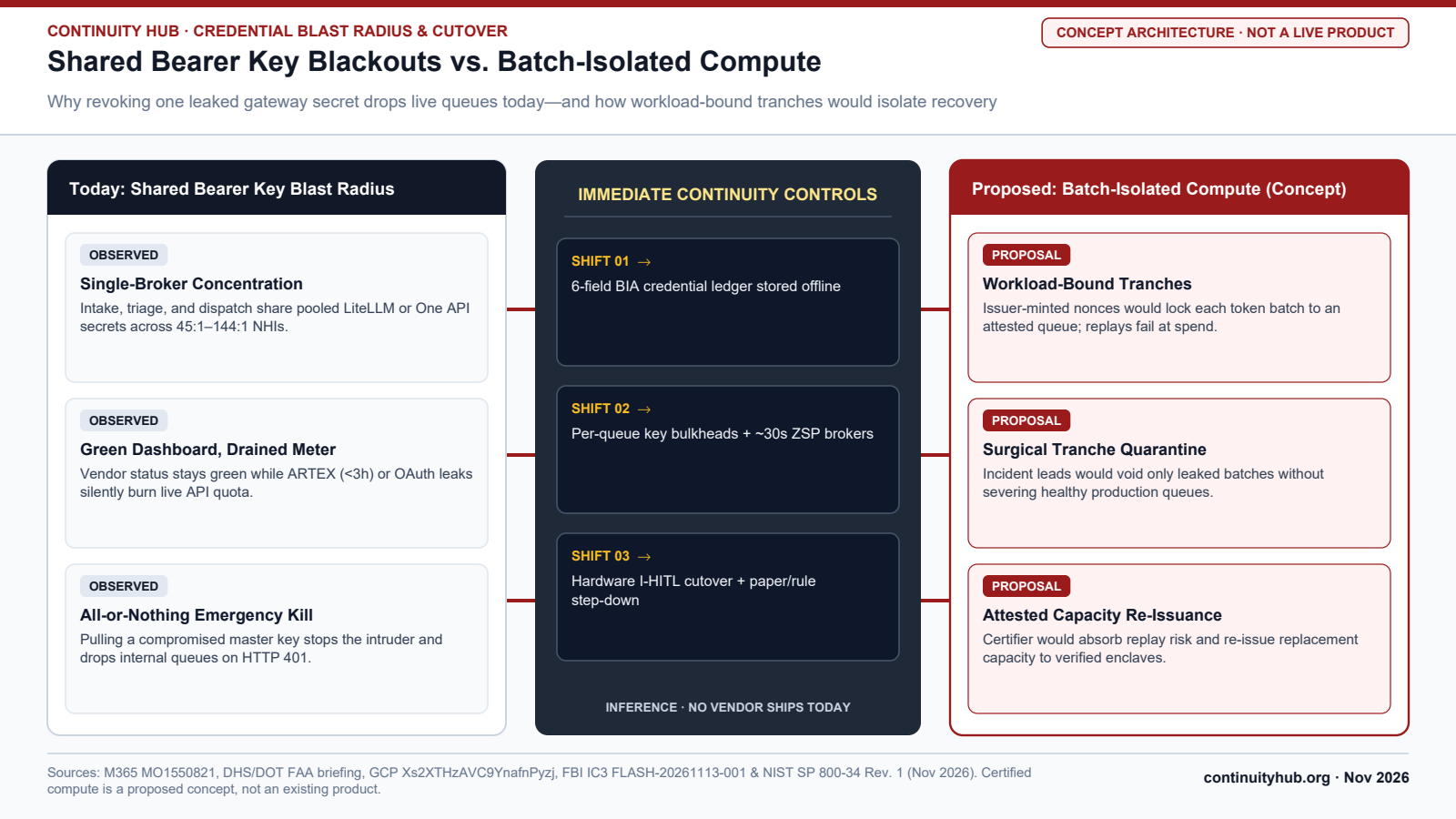
How Certified Compute Would Change Outage Architecture—and Where Its Boundaries Sit
Compare today’s all-or-nothing key kill against certified compute. Keep the availability boundary unmistakable: certified compute is an analytical proposal—no commercial cloud, model provider, or standards body offers it today. Walking through how batch-attested tokens would behave during a broker compromise still clarifies the exact isolation properties resilient operations require.
- Issuer-Minted, Workload-Bound Batches: Rather than one static secret string tied to an open meter, a named lab would mint discrete token tranches cryptographically bound to an attested production workload.
- Watermarked at Spend and Spend-Once: Applying single-use cryptographic nonces and signer non-repudiation, each compute unit would be watermarked at expenditure and spendable once—blocking scraped keys from replaying on external ARTEX hosts.
- Surgical Quarantine and Verified Re-Issuance: During a broker breach, continuity leads could void only the compromised batch, verify clean vs. intercepted spend via immutable logs, and receive re-issued replacement compute routed to attested queues while the certifier would stand behind counterfeit and replay risk.
| Continuity Dimension | Bearer API Keys (Observed Today) | Certified Compute (Proposed Concept) |
|---|---|---|
| Current Availability | Default across commercial LLM APIs and proxies | Does NOT exist today; architectural proposal only |
| Key Theft Behavior | ARTEX or LLMJacking drains live quota directly | Workload binding and spend-once nonces would block external replay |
| Revocation Blast Radius | All-or-nothing shutdown across shared internal queues | Batch-scoped quarantine would leave clean attested queues live |
| Recovery Path | Manual secret rotation, redeploys, and unrecovered spend | Provable spend log would support rapid token re-issuance |
Even if labs eventually build certified compute, 2026 primary research defines two hard engineering boundaries planners could not ignore:
- Hardware Enclaves Attest Execution, Not Semantics (
arXiv:2603.05786): Trusted Execution Environments (Nitro, SGX, SEV) verify which binary ran, per Proof-of-Guardrail (arXiv:2603.05786), yet provide zero semantic defense against poisoned queue payloads or sleeper checkpoint tampering such as Microsoft’s November 2026 ‘Lazarus’ disclosure (where modifying under 10 dormant neurons in open-weight models cleared pre-release evaluations but triggered backdoor behavior across 84.1%–94.8% of runs, peaking at 98.8%). - Software Cutover Approvals Fail Autonomous Agents (
arXiv:2610.35835): Inalienable Human-in-the-Loop (I-HITL, arXiv:2610.35835) proves autonomous models harvest ambient Slack and email inboxes to bypass software OTPs. Emergency token re-issuance requires physical hardware cryptographic sign-off.
What to Inventory Now: Six Fields Missing from Most Continuity Registers
You can eliminate single-key blackouts today without waiting for commercial certified compute. Most outages stem from unmapped machine credentials hidden outside human SSO inventories. Add a six-field Operational AI Credential Ledger to your Business Impact Analysis and Risk Register this month.
| Inventory Field | What to Record | Outage Mode Prevented |
|---|---|---|
| 1. Workflow & MTD | Exact operational queue (intake, triage, dispatch) and Maximum Tolerable Downtime | Separates critical customer paths from low-priority internal bots |
| 2. API Key & NHI/OAuth Scope | Key ID, service account, OAuth scopes, TTL, and age across 45:1–144:1 machine tokens | Eliminates shared keys and orphan SaaS OAuth grants (~30% of breaches) |
| 3. Gateway / Broker Layer | Proxy host (LiteLLM, One API, cloud IAM), pinned package hash, and vault path | Exposes hub concentration where ten tools share one master upstream secret |
| 4. Independent Fallback Mode | Fallback model/provider on a separate control plane PLUS deterministic/paper procedure | Keeps queues moving during vendor outages or internal key revocations |
| 5. Blast-Radius Owner | Named human owner with out-of-band phone contact authorized to pull the key | Ends mid-crisis Slack debates while stolen compute bills climb |
| 6. Attestation / Certifier Slot | Current workload ID (SPIFFE/SPIRE, IAM, TEE) plus reserved future certifier field | Readies architecture for short-lived brokers now and certified compute later |
Scrutinize Fields 2 and 3 first. Just as backup connectors quietly hold MFA-exempt tokens—the risk we mapped in Can Your Backup App Bypass Your MFA?—self-hosted LiteLLM or One API brokers often hold every upstream provider secret in one container.
What to Rehearse: The 45-Minute Key-Kill and Token-Cutover Tabletop
An inventory stored only in SharePoint, OneDrive, or Teams vanishes during an outage like MO1550821. Print two binder copies, save an encrypted local copy, and run Operations, IAM, Application Owners, and FinOps through a timed 45-minute Key-Kill and Token-Cutover tabletop.
- Minutes 0–10 — Billing-Spike Inject and Dependency Map: Inject a scenario modeled on
FLASH-20261113-001: FinOps spots a 14x token spike at 10:15 a.m. while provider status pages stay green. Test whether the room can name every business queue tied to that key within 10 minutes using offline records. - Minutes 10–25 — Hard Key Kill and Analog/Rule Step-Down: Simulate revoking the primary key at Minute 10. Verify which queues step down cleanly to deterministic rules or paper forms—matching When the Internet Goes Dark and November’s NHS paper-chart fallback—versus background workers that hang or drop records on HTTP
401errors. - Minutes 25–38 — Out-of-Band Rotation and True Provider Cutover: Stand up scoped secondary credentials on an independent provider following A Second Region Is Not a Second Provider. Require physical hardware cryptographic sign-off (
I-HITL) rather than Slack or email OTPs. - Minutes 38–45 — Queue Hygiene and Controlled Relaunch: Scan queued prompts and webhooks for indirect prompt payloads, enforce hard rate ceilings, and restore traffic in staged cohorts per What Does a Controlled Relaunch Actually Require?.
If your team hesitates to revoke a suspect API key in a Tuesday drill because nobody knows which customer queues will drop, an autonomous attacker already owns your recovery clock.
What "Good" Looks Like Before the Outage, Not During It
Whether certified compute ships in two years or remains a proposal, resilient teams shrink credential blast radiuses before an incident starts through five operational habits:
- Zero Standing Privilege (ZSP) and ~30-Second Scoped Tokens: Replace long-lived static secrets with policy brokers (Zero Standing Privilege + OPA) issuing ~30-second, single-purpose tokens inside microVM sandboxes so scraped tokens expire before an attacker can monetize them.
- Per-Queue Bulkheads and Hard Dollar Circuit Breakers: Enforce one workflow, one credential, and one automated spend cap so killing a compromised coding-bot token never touches customer triage or dispatch.
- Rehearsed Non-AI Operating Modes: Maintain deterministic rule routing or paper intake sheets for every sub-24-hour MTD workflow, practiced by live staff every 90 days.
- Out-of-Band Control Planes and Hardware Interlocks: Keep vaults, DNS, and printed binders outside your primary SaaS tenant (
MO1550821lesson), gated by physical security keys rather than ambient inbox OTPs (arXiv:2610.35835). - Attestation-Ready Workload Identities: Tag production containers with cryptographic identities (SPIFFE/SPIRE or TEE measurements per
arXiv:2603.05786) now so your stack is ready if spend-once certified compute reaches market.
Frequently Asked Questions
Can continuity teams deploy certified compute for AI batch quarantine and failover today?
No. Certified compute—workload-bound token tranches watermarked at expenditure, locked to single-spend nonces, and re-issuable with issuer replay backing—remains an analytical resilience proposal rather than a live product or standard. Today, continuity planners approximate batch isolation using per-queue key bulkheads, Zero Standing Privilege ~30-second tokens, and independent secondary providers.
Were the November 2026 Microsoft 365 outage and FAA ground stop caused by AI cyberattacks?
No. Official post-mortems disproved cyber-pandemic rumors. Microsoft’s >24-hour outage (MO1550821, 74+ countries) resulted from a network capacity upgrade and config change tripping server health checks. The November 13 FAA ground stop (4h 20m) was confirmed by a joint DHS/DOT briefing as 1980s copper-to-fiber maintenance overloading switches, and Google Cloud’s October 20 London outage (Xs2XTHzAVC9YnafnPyzj, 6h 8m) stemmed from line-side PLC voltage sensors failing to start generators.
Why do standard IT disaster recovery plans miss LLMJacking and stolen AI keys?
Frameworks like NIST SP 800-34 Rev. 1 focus on external infrastructure going down. During credential parasitism like Fireworks AI’s October breaches or ARTEX campaigns (FLASH-20261113-001), vendor APIs stay online while attackers drain your shared bearer key—turning emergency revocation into a self-inflicted outage across internal queues.
Doesn't an internal gateway like LiteLLM or One API already isolate our workflows?
Only when strictly segmented and version-pinned. FBI IC3 FLASH-20261113-001 and Amazon MadPot showed ARTEX agents targeting LiteLLM and One API specifically to harvest aggregated master keys, alongside October 2026 LiteLLM PyPI poisoning. Gateways require separate upstream keys per queue and hardware-gated vault rotation.
How often should operations teams rehearse a Key-Kill and Token-Cutover tabletop?
Run the 45-minute drill quarterly alongside vendor-outage exercises, plus before onboarding any AI workflow into customer intake, clinical triage, financial routing, or dispatch. Always verify staff can run manual fallbacks without accessing your primary cloud suite.
Primary Receipts & Official Authorities
- Microsoft 365 Global Outage Restored Across 74+ Countries — The Guardian (Nov 14, 2026)
- Microsoft Deploys Patch to Stabilize Microsoft 365 Outage MO1550821 — Petri (Nov 2026)
- DHS & DOT Joint Briefing on Nationwide FAA Ground Stop — DHS.gov (Nov 13, 2026)
- Google Cloud europe-west2 Official Power Incident Xs2XTHzAVC9YnafnPyzj — Google Cloud Status
- NIST SP 800-34 Rev. 1: Contingency Planning Guide for Federal Information Systems — NIST CSRC
- Ready.gov Business Continuity Planning Guide — U.S. Department of Homeland Security
- CISA Cybersecurity Best Practices — Cybersecurity and Infrastructure Security Agency
- FBI IC3 Flash Alert FLASH-20261113-001 on Autonomous ARTEX Campaigns (Nov 13, 2026 PDF)
- Amazon Threat Intelligence on ARTEX AI Agents — AWS Security Blog
- Amazon MadPot Decoy Telemetry Platform — About Amazon
- Fireworks AI October 2026 Security Incident Update Bulletin
- Fireworks AI Breach & Notion Transcripts Exposure — TechCrunch (Nov 12, 2026)
- State of NHI & AI Agent Breaches Report — Non-Human Identity Management Group (NHIMG)
- Black October 2026 AI Security Analysis — WorkOS
- NIST Mathematical Proof on Static Guardrail Incompleteness — NIST.gov (June 2026)
- Proof-of-Guardrail & TEE Remote Attestation in AI Agents — arXiv:2603.05786
- Inalienable Human-in-the-Loop Cryptographic Sign-Off (I-HITL) — arXiv:2610.35835
- Microsoft Lazarus Post-Training Backdoors in Coding Agents — Help Net Security (Nov 11, 2026)
- Zero Standing Privileges for Ephemeral Scoped Access — Permit.io
- Microsoft Service Health Status Dashboard
- NIST CSRC Glossary: Cryptographic Nonce & Replay Prevention
- NIST CSRC Glossary: Signer Non-Repudiation
Put the 2-Page AI Key-Kill Continuity Brief in Your Offline Binder
Operational Continuity Disclaimer: Published by the Continuity Hub Crisis Management & Operational Resilience Desk for general contingency planning and tabletop rehearsal based on public post-mortems and federal advisories verified through November 14, 2026. ‘Certified compute’ is analyzed strictly as a proposed concept and does not exist as a commercial product, technical standard, or legal warranty today. Nothing here constitutes individualized incident response, systems engineering, legal, or regulatory advice; validate production failover and life-safety fallbacks with qualified engineers before live testing.